Greenwashing in Interiors: 10 Claims Every Buyer Should Question Before Specifying a Product
“Eco-friendly” is not enough. Learn the ten product claims every buyer should test—and the evidence that belongs in a defensible specification.
How to turn vague environmental language into verifiable product requirements
A sustainability claim should help you make a decision. If it cannot tell you what was measured, how it was measured and who checked it, it is not ready for a specification.
“Eco-friendly.” “Natural.” “Non-toxic.” “Made with recycled content.” These phrases sound reassuring, especially when you are comparing dozens of products under time pressure.
The problem is not that every claim is false. Many are technically true. The problem is that a claim can be true and still leave out the detail you need to make a responsible buying decision.
A product may contain one recycled component and still be difficult to repair. A finish may be labelled low-VOC because of its ingredients, while the finished product has not been tested for emissions. A chair may carry a company-level sustainability badge that does not apply to that exact model. The language sounds clear; the evidence often is not.

A sustainability claim is only as useful as the evidence behind it.
The Real Problem Is Missing Context
Environmental marketing often focuses on one positive attribute without explaining the boundary around it. Is the claim about the whole product, one component, the packaging, the factory or the company? Is it based on a test, a calculation, a self-declaration or independent certification?
The U.S. Federal Trade Commission advises against broad, unqualified claims such as “green” or “eco-friendly” because they are difficult to substantiate. ISO 14021 likewise provides requirements for self-declared environmental claims. The practical lesson for a buyer is simple: never stop at the adjective.
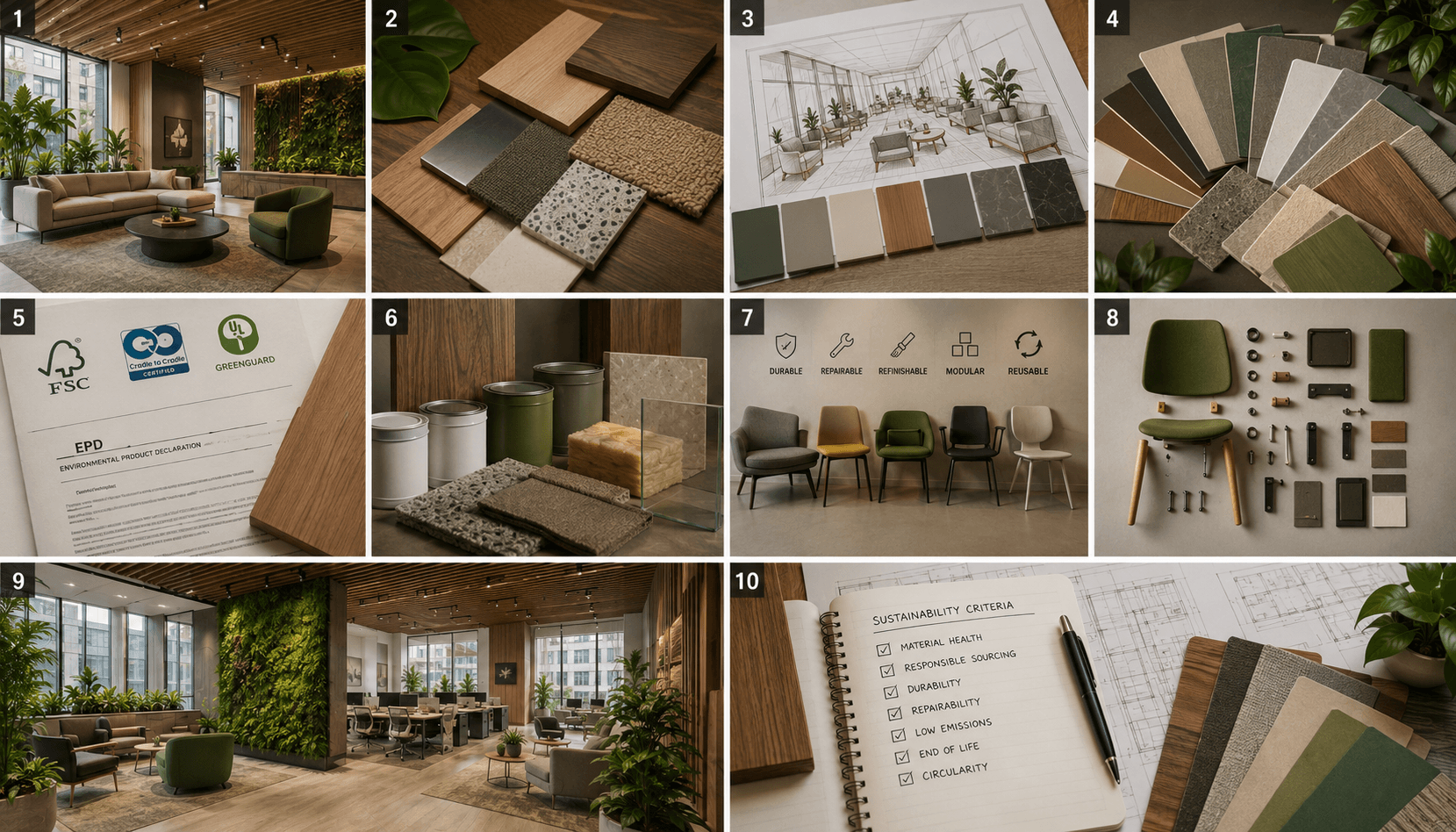
A claim about one visible attribute may not describe the whole product.
Ten Claims Worth a Second Look
- 1. “Sustainable,” “green” or “eco-friendly”: Ask which specific impact is better, compared with what, and across which stage of the product’s life. A broad claim is not a performance requirement.
- 2. “Natural”: Natural does not automatically mean safer, lower-carbon or responsibly sourced. Ask for the ingredients, processing methods, origin and relevant health or environmental evidence.
- 3. “Non-toxic” or “chemical-free”: Everything is made of chemicals. Ask which substances were assessed, for which exposure route and against what threshold. Product-content disclosure, such as an HPD, can provide useful detail, but disclosure is not the same as certification.
- 4. “Low-VOC” or “zero-VOC”: Clarify whether the claim refers to VOC content in a wet product or emissions from the finished material. Ask for the test method, product scope and current certificate. GREENGUARD, for example, addresses chemical emissions; it does not certify every aspect of sustainability.
- 5. “Recycled” or “made with recycled content”: Ask for the percentage, whether it is pre-consumer or post-consumer, and whether it applies to the whole product or one component. “Contains recycled material” could mean almost anything without a number.
- 6. “Recyclable” or “circular”: Can the product actually be collected, separated and recovered where the project is located? Does it come apart without destroying the materials? Is there a take-back route, or is recyclability only theoretical?
- 7. “Renewable,” “bio-based” or “responsibly sourced”: Ask what percentage qualifies, where it comes from and how the supply chain is tracked. For timber, an FSC claim should be supported through chain-of-custody documentation—not assumed from a logo shown elsewhere.
- 8. “Biodegradable” or “compostable”: Under what conditions, and in what timeframe? A product that breaks down in an industrial facility may not do so in a landfill, a home compost system or the environment.
- 9. “Carbon-neutral” or “net-zero product”: Ask for the assessment boundary, baseline year, life-cycle stages, reductions already achieved and the role of offsets. A carbon claim without those details is difficult to compare or rely on.
- 10. “Certified,” “compliant” or “verified”: Certified to what exact standard, by which organization, for which product and for how long? An EPD discloses verified life-cycle impact data but does not automatically prove that one product is better. BIFMA LEVEL is a multi-attribute furniture certification, while other programmes may assess only one issue.
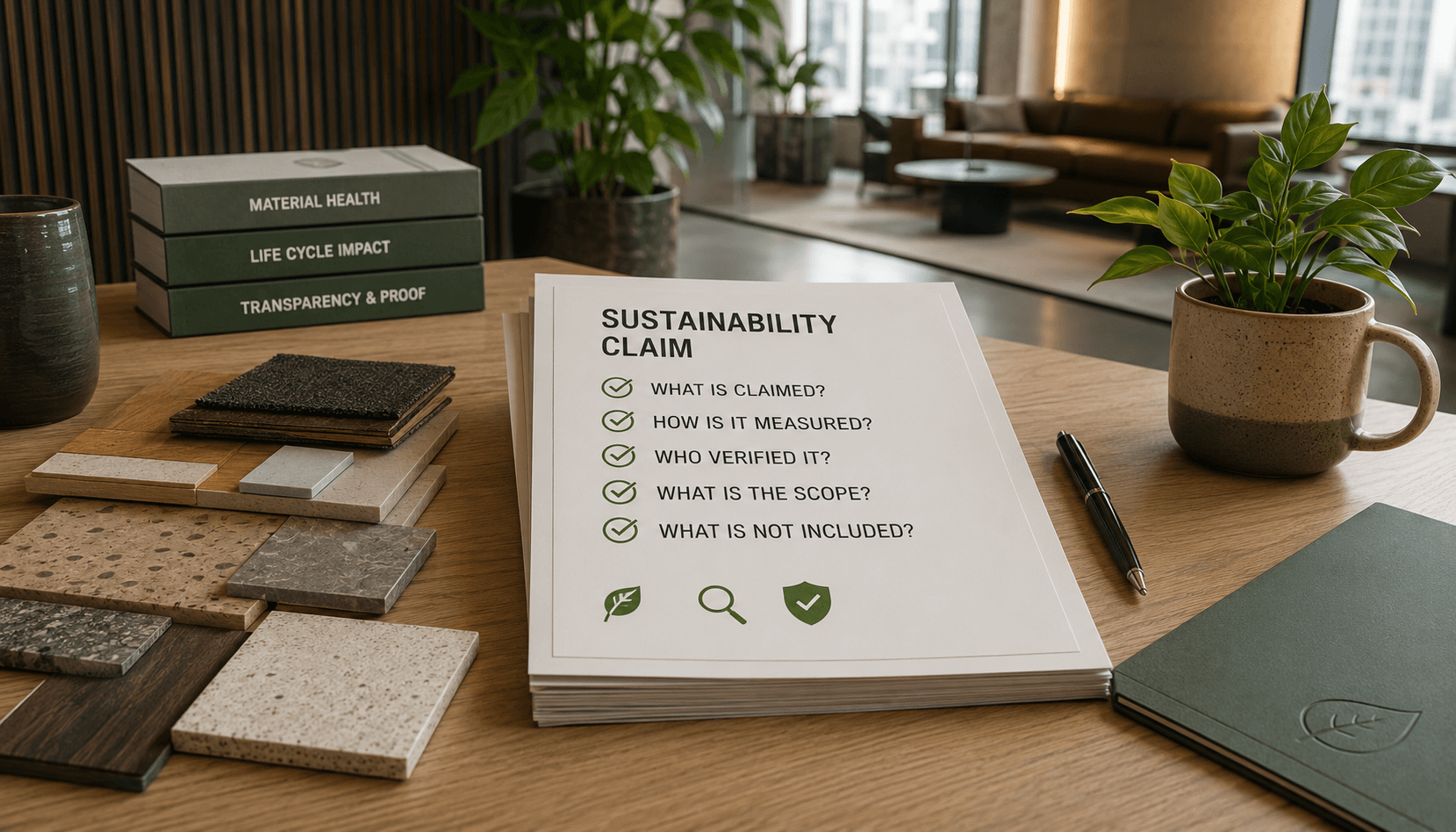
Good procurement turns environmental language into product-specific evidence.
A Simple Evidence Test for Every Claim
You do not need to become a materials scientist to challenge greenwashing. You need a repeatable procurement habit. For every meaningful claim, ask for six things:
- The claim: the exact environmental or health benefit being promised.
- The scope: the product, component, packaging, factory or company it applies to.
- The metric: a percentage, emission limit, impact result or other measurable value.
- The method: the standard, test protocol, product category rule or calculation used.
- The verifier: who checked the information, and whether they are independent.
- The applicability: certificate number, product model, geography, issue date and expiry date.
EPA’s purchasing recommendations are useful because they point buyers toward product-category-specific standards and ecolabels rather than one universal “green” badge. The right evidence depends on what you are buying and which risk you are trying to control.
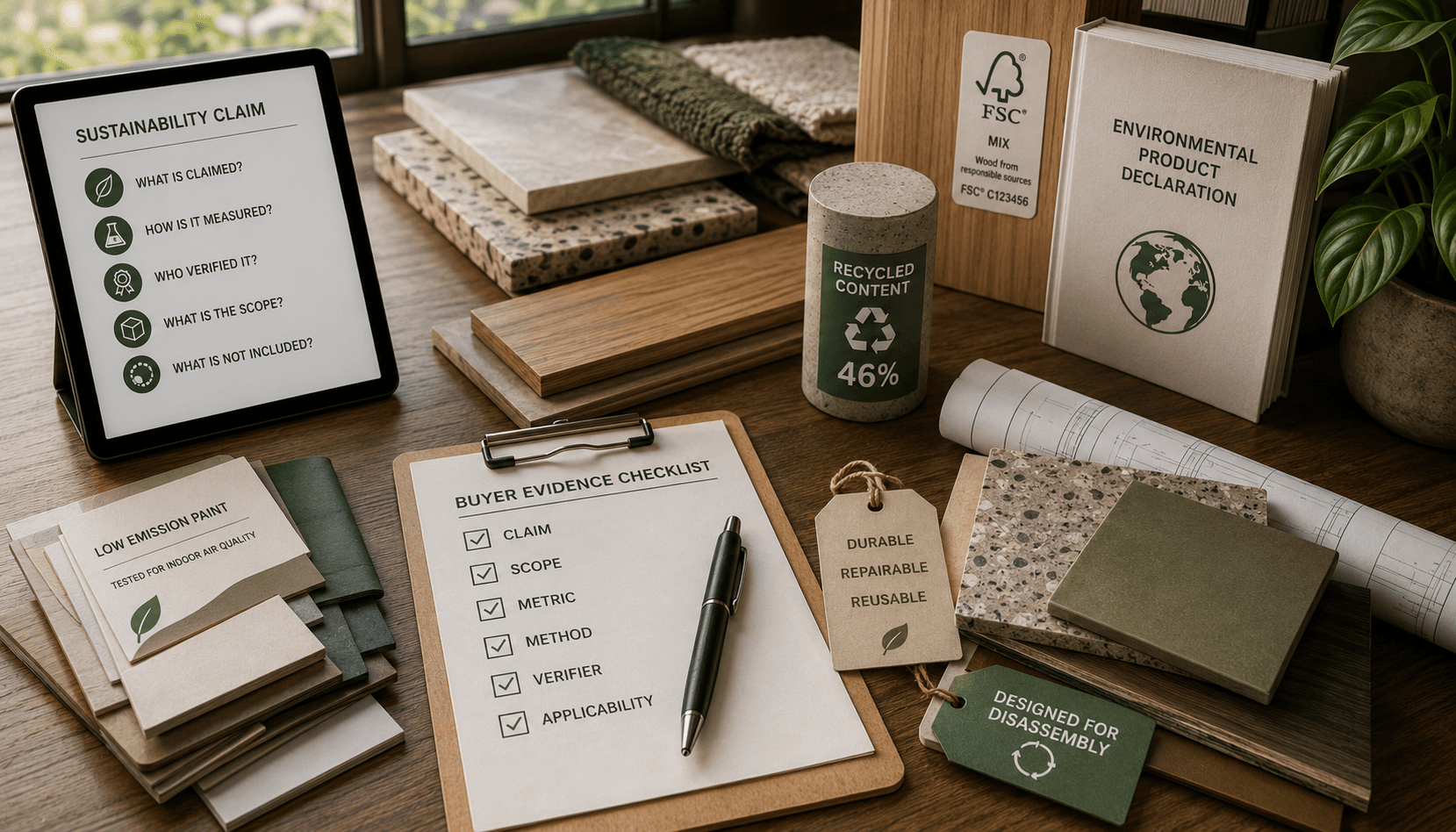
Better evidence supports healthier, more credible and more durable interior choices.
What Changes When the Specification Requires Proof
The conversation becomes more useful. Suppliers know exactly what documentation is required. Designers can compare products on the same basis. Procurement teams are less exposed to last-minute substitutions, unsupported claims and reputational risk.
It also improves the final interior. Better evidence can support lower-emitting materials, more credible sourcing, clearer carbon data, repairable products and stronger end-of-use planning. The goal is not to find a perfect product. It is to make the trade-offs visible before the purchase order is issued.
Five Questions for Your Next Supplier Call
- 1. What exactly does this claim apply to?
- 2. What number, test result or percentage supports it?
- 3. Which standard or method was used?
- 4. Who verified it, and is the document current for this exact product?
- 5. What does the evidence not cover?
The strongest suppliers will not be offended by these questions. They will usually be relieved that the buyer understands the difference between marketing language and product evidence.
“FINAL TAKEAWAY Greenwashing loses its power when specifications stop rewarding adjectives and start requiring proof.”
At a glance
- 1
Learn why 'eco-friendly' or 'natural' claims are insufficient for decision making.
- 2
Identify 10 common claims that need questioning, from 'low-VOC' to 'carbon-neutral'.
- 3
Adopt a simple, repeatable six-part evidence test for any product specification.
Sources & further reading
- U.S. Federal Trade Commission — Environmental Claims: Summary of the Green Guides
- ISO — ISO 14021:2026, Self-declared environmental claims
- U.S. EPA — Recommendations of Specifications, Standards and Ecolabels for Federal Purchasing
- HPD Collaborative — HPD Open Standard
- UL Solutions — GREENGUARD Certification
- EPD International — Environmental Product Declarations
- BIFMA — LEVEL Certification
- Forest Stewardship Council — Chain of Custody Certification
Stay Inspired.
Stay Informed.
We respect your privacy. Unsubscribe anytime.