
Where Is Your Project Budget Quietly Going to Waste?
Waste does not only sit in a skip. It hides in over-ordering, storage, damage, rework and weak supplier terms. Here is how project teams can find it and prevent it.
Waste is not only what leaves the site in a skip. It is the money lost through over-ordering, damage, storage, rushed substitutions, rework and products that fail too soon.
Waste is almost always discussed as an environmental problem. On an interior project, it is also a budget problem—and usually a hidden one.
A surplus box of tile may seem minor. So does one damaged chair, an extra delivery, a last-minute material change or a few days of storage. But when those costs are spread across procurement, logistics, labour and disposal, they stop looking like waste. They simply disappear into the project.
That is how a project can finish close to its headline budget and still lose money through decisions that created no lasting value.

Small waste becomes budget leakage
The Real Problem: Waste Is Scattered Across the Budget
Most teams look for waste at the end of the job, when skips are removed and leftover materials are counted. By then, much of the financial damage has already happened.
The order may have been placed before measurements were confirmed. A finish may have been approved without checking minimum quantities. Furniture may have arrived too early and needed storage. Products may have been handled twice, damaged, replaced or removed after a design change.
Each cost lands somewhere different. That makes the total easy to underestimate—and hard for any one person to own.
Where the Money Actually Leaks
- Design: over-specification, late changes, uncoordinated drawings and products that cannot be repaired or adapted.
- Procurement: inaccurate quantities, unsuitable pack sizes, unnecessary safety margins, weak substitution control and unclear return terms.
- Logistics: split shipments, rushed freight, off-site storage, repeated handling and deliveries that do not match installation.
- Site: poor protection, damage, incorrect installation, missing information and rework caused by coordination gaps.
- End of use: products with no take-back, reuse, resale or recovery route, even when they still have useful value.
The U.S. EPA encourages teams to treat construction and demolition materials as resources that can be reduced, salvaged and reused—not simply as debris. The cheapest waste to manage is the waste that was never ordered, damaged or removed.
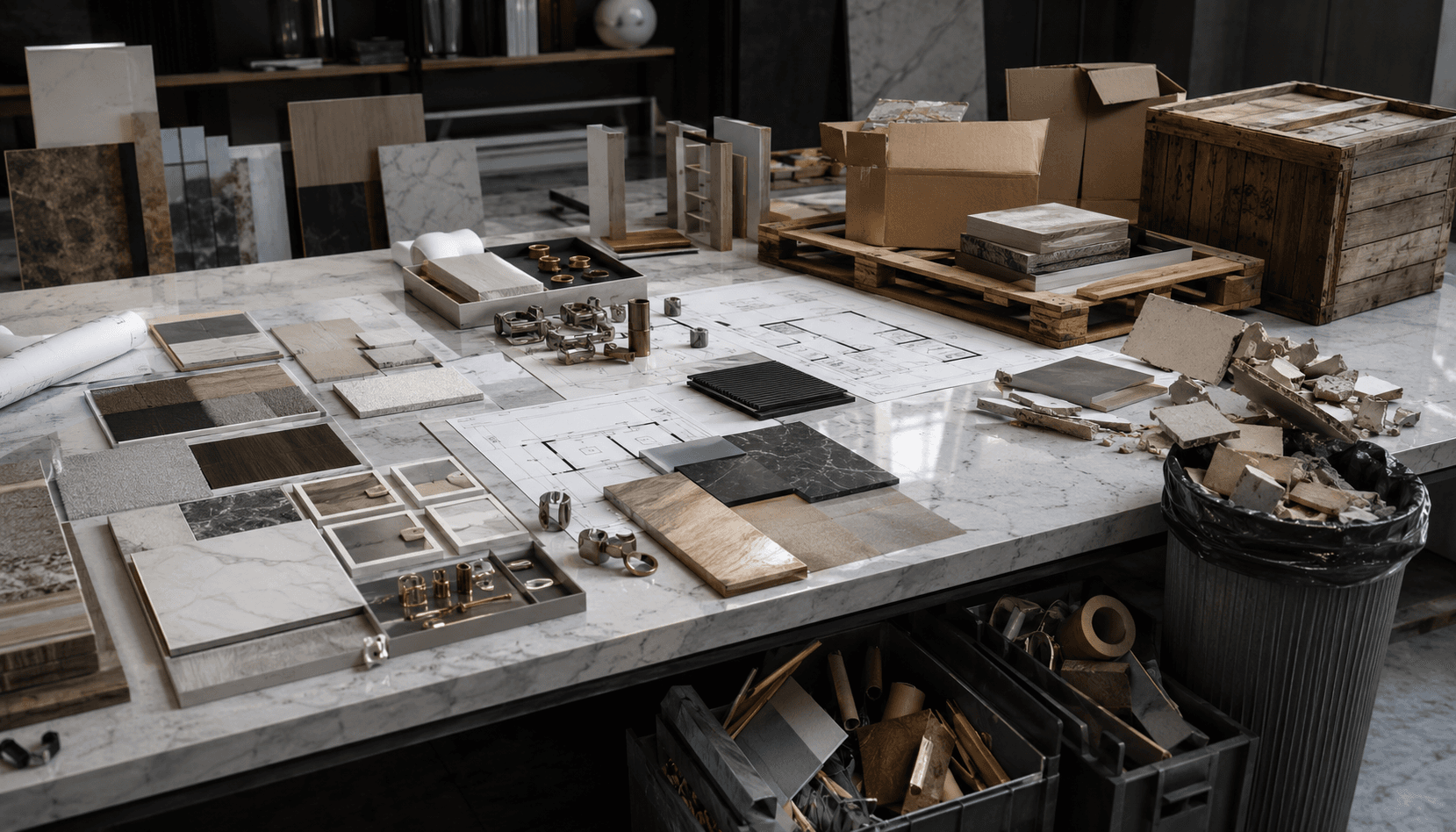
Waste created before disposal
Why the Conventional Approach Misses It
The usual approach is to place disposal under general conditions, carry a broad contingency and deal with issues as they appear. It is reactive, and it hides the causes.
Information gaps make the problem worse. A PlanGrid and FMI study found that poor communication and inaccurate or inaccessible project information accounted for 48% of reported rework. Interior projects are particularly exposed because design, product data, approvals, purchasing and installation sequencing often sit with different teams.
A Better Way: Manage Waste Before It Exists
- 1. Create a waste register during design. List likely waste streams—finishes, furniture, millwork, packaging, mock-ups and replaced items—and assign an owner.
- 2. Verify quantities before purchase. Use coordinated drawings, field measurements and approved schedules rather than preliminary assumptions.
- 3. Ask the practical questions. What are the minimum quantities? Can unopened products be returned? Are spare parts available? Can one damaged component be replaced?
- 4. Plan delivery around installation. The right product arriving at the wrong time can still create storage cost, damage and double-handling.
- 5. Track what happened: what was ordered, installed, returned, damaged, reused, donated, recycled and discarded—along with the cost.
- 6. Review the data before the next project. Use it to improve specifications, allowances, supplier terms and ordering behaviour.

Sequenced delivery prevents loss
WRAP’s former built-environment programme reported that more than 800 participating companies diverted millions of tonnes of waste from landfill while realising substantial annual cost savings. The scale varies by project, but the lesson is simple: waste falls when it is managed as a commercial issue, not a housekeeping task.
The Conventional Way Versus the Better Way
CONVENTIONAL APPROACH
Track dumpsters, absorb small overruns across several cost codes and discuss waste after installation.
BETTER APPROACH
Track the decisions that create waste from design through procurement, delivery, installation and end of use.
What Changes When Waste Becomes a Budget Metric
The immediate benefit is not only a smaller disposal bill. Teams can reduce excess purchases, urgent freight, storage, handling, replacement orders, rework and schedule disruption.
The longer-term benefit is better information. Designers learn which details create offcuts. Procurement teams see which suppliers have difficult pack sizes or weak return policies. Project managers identify where damage occurs. Owners see which products retain value and which become liabilities.
It also supports circularity. Durable, repairable, modular and reusable products are easier to keep in service and recover when the interior changes.
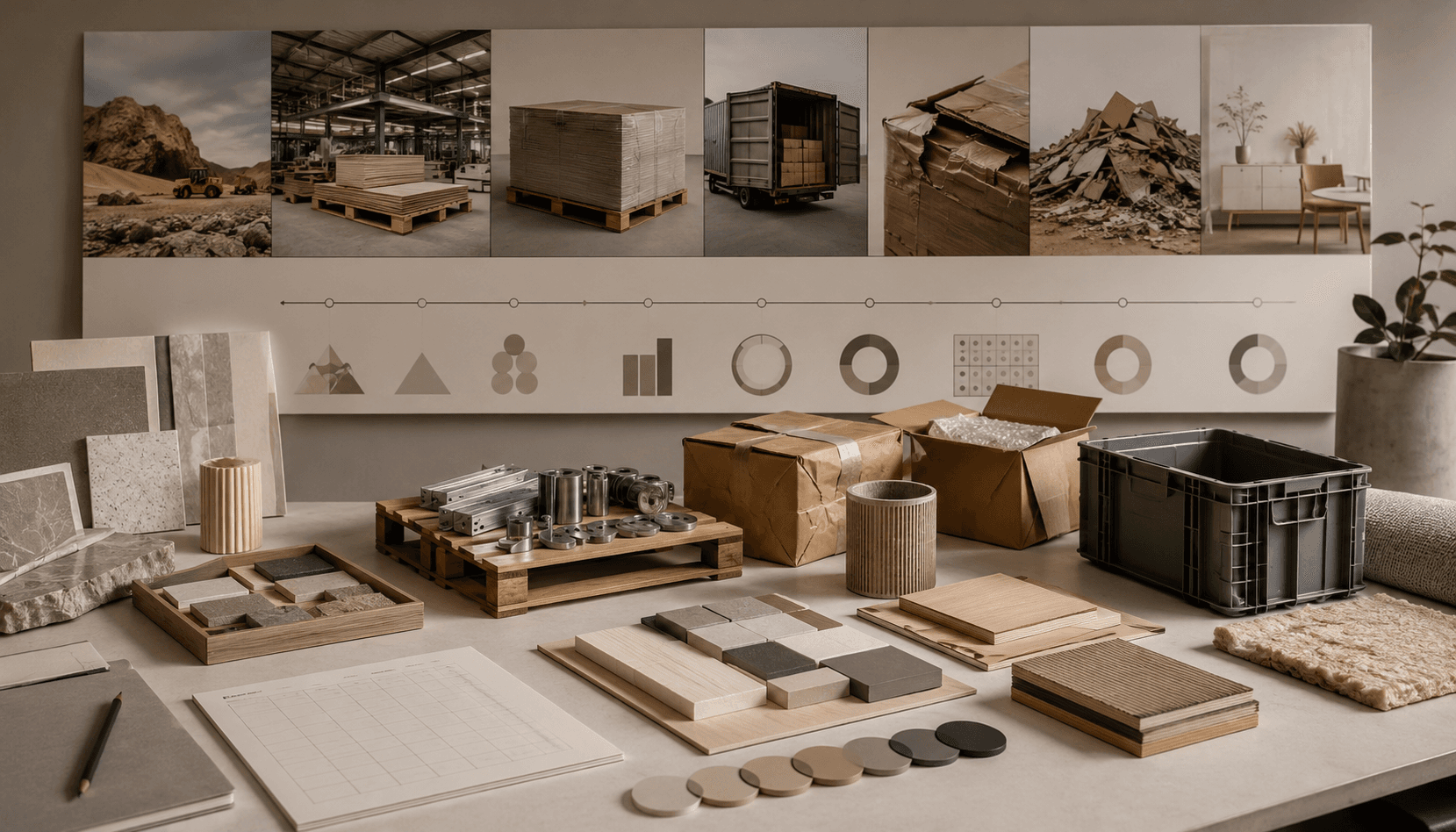
Products retain value through recovery
Five Questions for Your Next Project Meeting
- 1. Which decisions are most likely to create excess, damage or rework?
- 2. Have final quantities been checked against coordinated drawings and site conditions?
- 3. Do supplier terms cover returns, spare parts, take-back and damaged deliveries?
- 4. Is the delivery sequence aligned with storage capacity and installation?
- 5. How will we measure the cost of waste—not only the volume leaving the site?
Protecting the budget requires more than negotiating the purchase price. It requires visibility across the full journey of every product and material.
Once waste is treated as a cost created by decisions—not an unavoidable pile at the end—it becomes something a team can prevent, measure and improve.
“PRACTICAL TAKEAWAY Waste is not a rounding error at the end of a project budget. It is a series of preventable decisions hiding inside material, freight, storage, labour, disposal and rework.”
At a glance
- 1
Find out why material waste is a budget problem, not just an environmental one.
- 2
Identify the hidden costs of over-ordering, rework, storage and damage.
- 3
Learn a six-step process to manage waste before it physically reaches the site.
Sources & further reading
- U.S. Environmental Protection Agency — Sustainable Management of Construction and Demolition Materials
- U.S. Environmental Protection Agency — Best Practices for Reducing, Reusing and Recycling C&D Materials
- WRAP — Low Carbon & Resource Efficient Construction Procurement
- WRAP — Built Environment Programme
- PlanGrid and FMI — Construction Disconnected
- RICS — Whole Life Carbon Assessment for the Built Environment
- Ellen MacArthur Foundation — First Steps Towards a Circular Built Environment
Stay Inspired.
Stay Informed.
We respect your privacy. Unsubscribe anytime.