Why e-nviroGreen Exists
The challenge is not a lack of good intentions. It is what happens to those intentions when a project actually has to be delivered.
OPENING SCENE: THE QUESTION
In 2024, at an industry conference, the Director of Sustainability of an architecture and design firm was speaking about how sustainability was incorporated into their projects.
I asked whether sustainability starts losing priority as a project gets closer to the business end—budgets, procurement, timelines, construction and delivery.
Her answer (with a mix of disappointment and laugh): Yes, particularly on private projects! Sustainability may start as an important objective, but commercial realities can gradually push it down the priority list.
That stayed with me because it reflected a much wider industry problem: “what gets lost between intention and delivery.”
ACT I: THE CHALLENGE
The architect or designer has a design intent.
The client is investing real money and has expectations around cost, quality and schedule.
The estimator has to make the numbers work.
Procurement has to understand what can actually be sourced, at what price and within what lead time.
Sustainability & Engineering objectives need to survive those decisions.
Manufacturers and suppliers have their own production and logistics realities.
Everyone may be doing their job properly, and the project can still suffer.
Specifications change - Information in silo – A new project manager comes in – the previous one left the organizations - Someone works from an older version - A product becomes unavailable - An alternative is proposed - Numbers have to be revisited - Procurement compares again - Design reviews again - The client approves again.
Change itself is not the problem. Real projects will always change.
The problem is the unnecessary repetition and loss of information created when connected decisions are being made through disconnected processes.
We talk about material waste, packaging, offcuts and landfill because we can see them. But what about the waste of time, money, information and human effort, and the stress thereof? And along the way, design intent can gradually get diluted.
Sustainability is caught in the same process. It may be important at the beginning, but once budgets tighten and deadlines become real, it starts having to justify itself again and again.
ACT II: THE DIAGNOSIS
It is easy to call this a design problem, procurement problem, sustainability problem, communication problem or technology problem.
In many cases, the real loopholes are between them.
A designer may specify the right product, but procurement may not know why a certain feature matters. Procurement may find a better commercial option, but its effect on design, performance or sustainability may not be obvious. The estimator may have priced the correct information at that time, but the information changes later. The client may eventually be asked to decide mainly around cost because all the implications are not visible together.
That does not mean one stakeholder is doing something wrong.
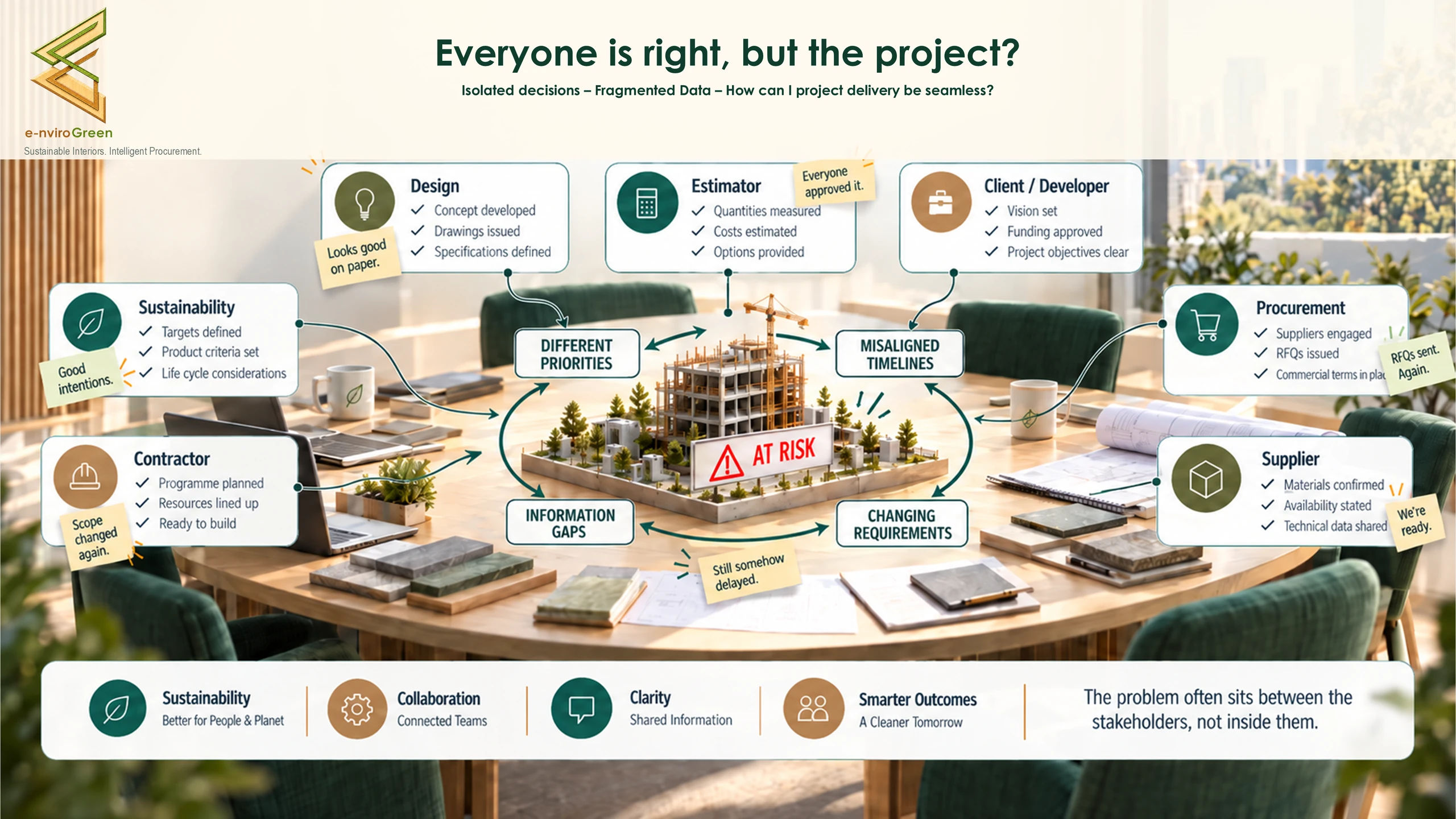
Designers understand design. Estimators understand cost. Procurement understands sourcing and commercial reality. Manufacturers understand their products. Sustainability professionals understand environmental impact. Clients understand what is commercially possible.
The issue is how those decisions connect and the people working on their respective roles start thinking not for the role, but the project goal!
Sustainability makes this particularly clear. A responsible product still has to look good, perform, fit the budget, be available and arrive on time. A client cannot simply be asked to ignore cost or practicality because something is more sustainable.
For sustainability to become normal, the responsible option needs to compete as far as possible on design, cost, performance and practicality.
This thinking goes back much further than the 2024 conference. Architecture and climatology introduced the relationship between buildings, nature, materials and climate. Construction management added budgets, schedules and execution. An earlier attempt at building e-nviroGreen added another lesson: a sustainable idea also needs a sustainable business around it.
Years across interiors, furniture, manufacturers, suppliers, procurement and project delivery then made the gap between a good intention and the final outcome much clearer.
There have been many ideas and dreams along the way. Some stayed, some did not.
This one stayed because the problem never went away !!
ACT III: THE RESPONSE
That is where e-nviroGreen today comes from:
Sustainable Interiors. Intelligent Procurement. Technology-enabled Project Delivery.
These are connected because the problems are connected.
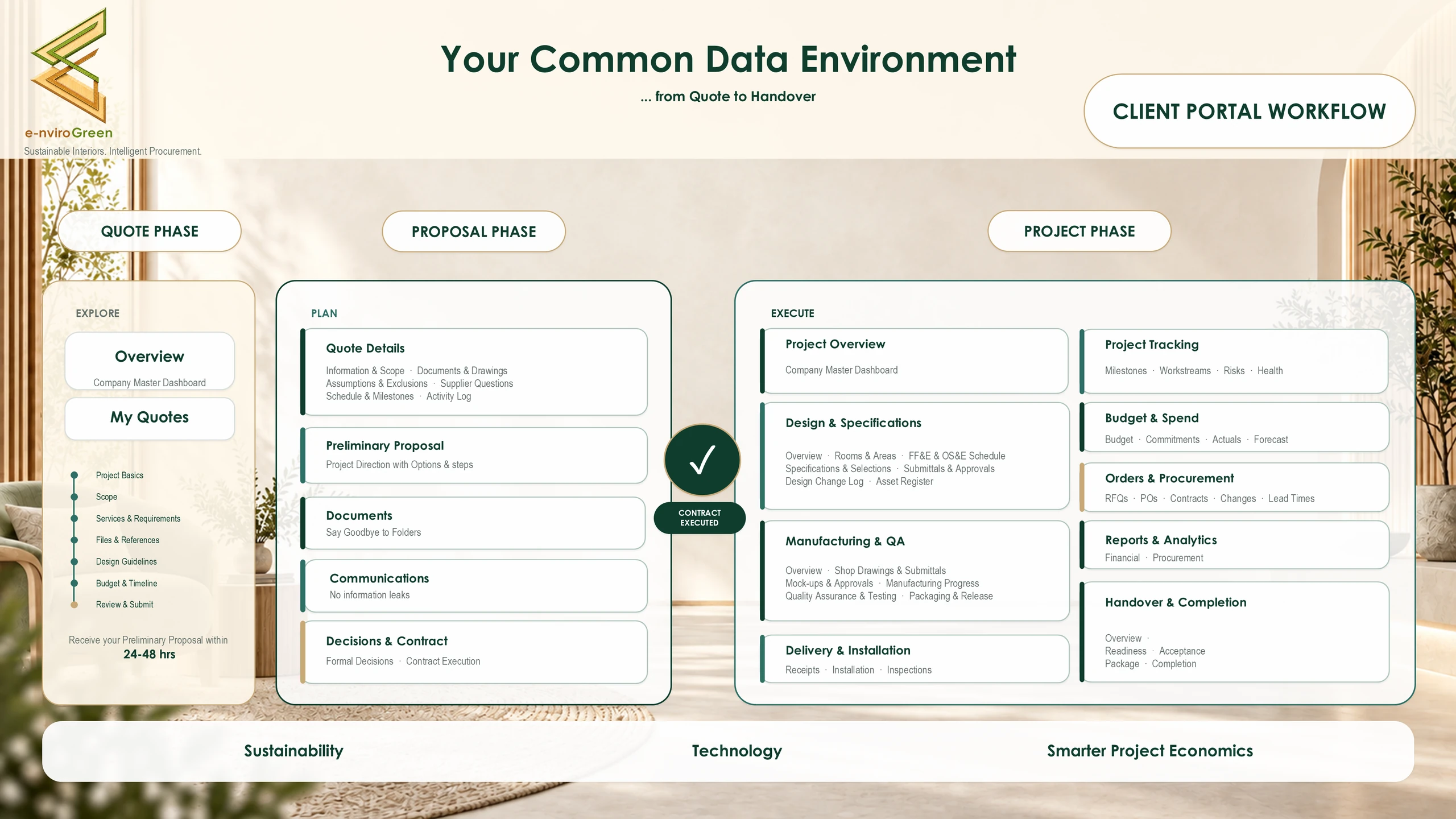
Sustainable interiors cannot stop at selecting a better material - that choice still has to survive sourcing, procurement, manufacturing, delivery and execution.
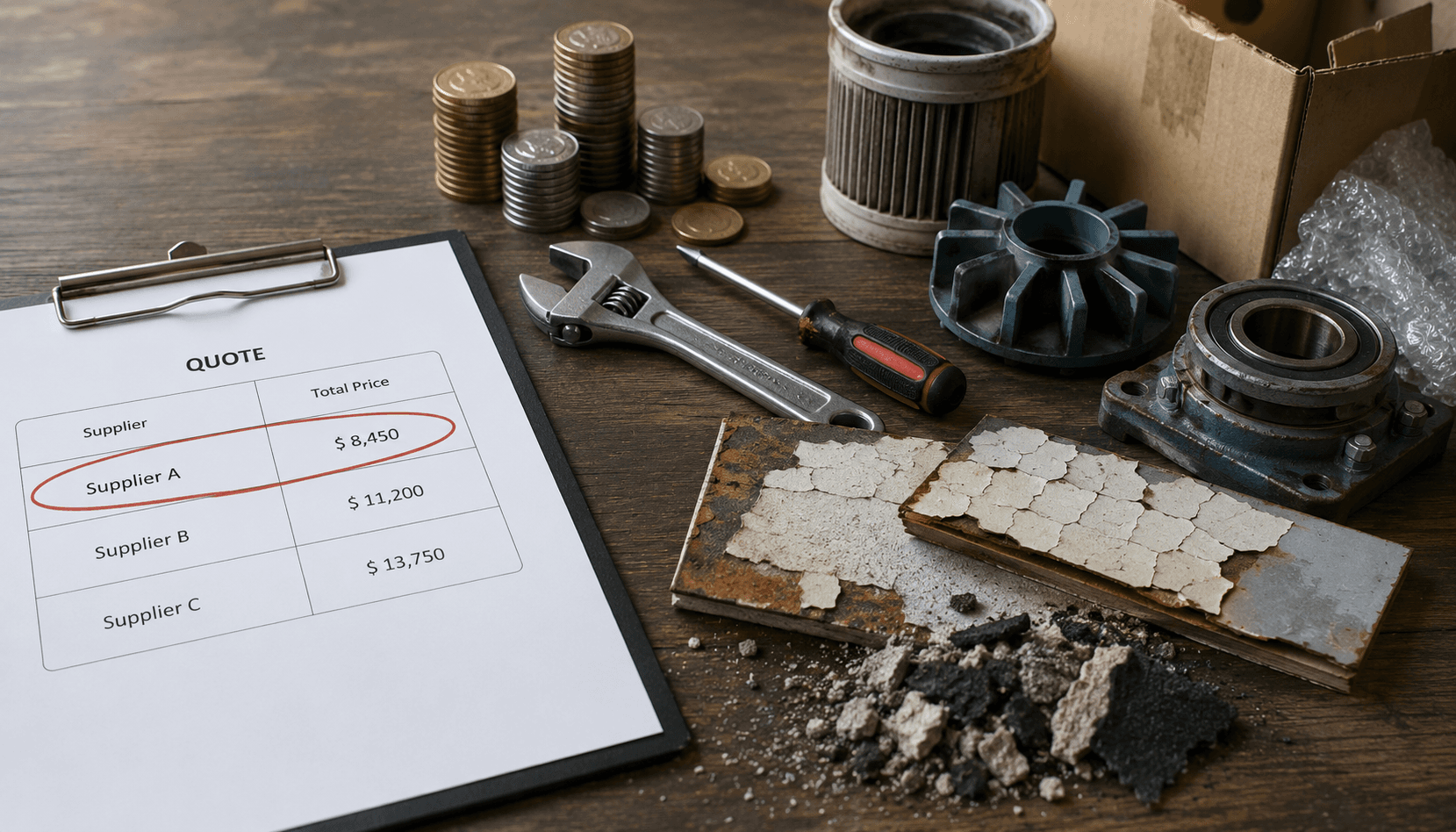
Procurement cannot only be about the lowest price - A cheaper option may become a poor decision if it compromises design, quality, performance or longer-term value.
Technology is useful only when it actually makes the process easier - If it creates another place to update, another place to search and another source of disconnected information, then the problem has simply moved somewhere else.
The objective is NOT to add another layer or replace architects, designers, estimators, procurement professionals or project managers. It is to help the existing process work better: clearer information, less unnecessary repetition, better understanding of what a change affects, and better-informed decisions.
The solutions will keep evolving because the challenges will keep evolving.
The approach is simply to: identify the real problem - understand why it exists - find a practical solution - and then see whether the outcome actually improved.
“PROBLEM – DIAGNOSIS – SOLUTION – IMPACT”
FINAL ACT: THE IMPACT
A better project does not mean there will be no compromises. Budgets, timelines and difficult decisions will always exist.
The difference is whether those decisions are informed.
That means giving clients better visibility before decisions become expensive to reverse, helping designers protect intent, reducing repeated work for estimators and procurement teams, keeping sustainability present when commercial pressures increase, and giving manufacturers and suppliers clearer requirements, all in terms of time, money, efforts and stress - thinking about sustainability beyond materials and energy!
No single company or technology will solve every problem in this industry.
The point is to keep identifying the loopholes, solve the ones that can be solved, and keep evolving when new ones appear.
That is why e-nviroGreen exists – not only because there was a dream, but because there was, and still is, a genuine problem behind that dream.
If the problem had disappeared, probably the dream would have disappeared too.
It didn't.
And solving it will require clients, architects, designers, estimators, sustainability professionals, manufacturers, suppliers, procurement teams and project teams working together.
And we will keep blooming — together.
Yours Sustainably,
Ashu